
30 written chapters · 1 published teaching videos
Grade 7, one chapter at a time.
Strengthen proportional reasoning and use rational numbers to model change. Connect equations, geometry, and probability to practical questions where units and assumptions matter.
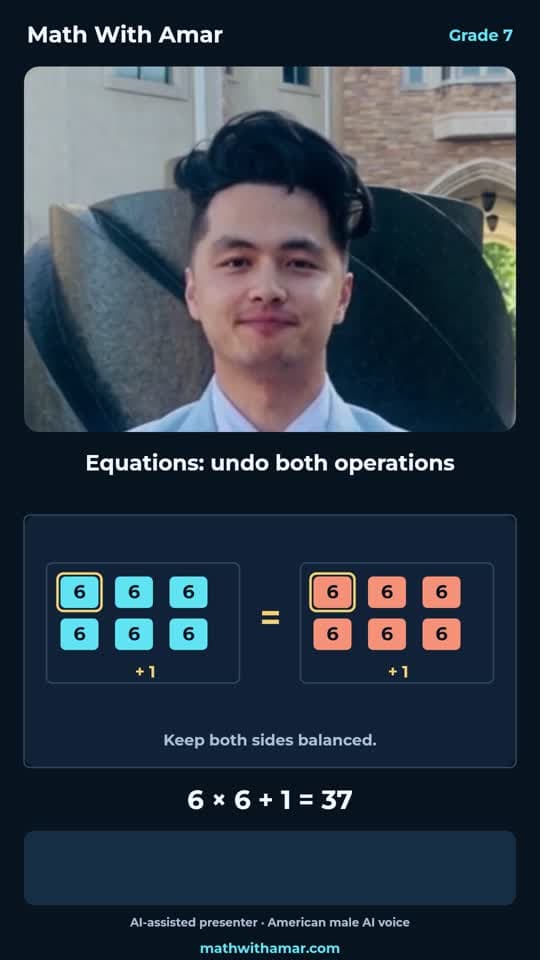
Watch, understand, then try it
Watch this grade’s teaching clips
Short explanations with animated examples, captions, and a full transcript. Each video opens beside its matching practice question so you can try the idea yourself.
Explore the complete written study sequence
1 short teaching clip is available above, each linked to its exact practice question. Every chapter below opens a written lesson with worked examples and practice. Full lesson recordings are being prepared; the interactive animations are available now.
Explore this level’s 100 interactive animationsFollow the learning sequence
Chapters and video availability
Each chapter follows an existing academy lesson. Numbers match the written study order; grade placement is a guide and school sequences may vary.
30 of 30 chapters · in study order
Chapter 1 · Algebra
Find a rate when both quantities are fractions
Dividing two measured fractions gives the amount per one unit of the denominator quantity.
Written lesson available · video pending
Study this chapterChapter 2 · Algebra
Recover the constant of proportionality
A proportional relationship has one output-to-input ratio and passes through the origin.
Written lesson available · video pending
Study this chapterChapter 3 · Algebra
Detect a fixed fee in a table
A constant rate of increase does not make a relationship proportional when there is a nonzero starting fee.
Written lesson available · video pending
Study this chapterChapter 4 · Geometry
Convert a map length with a scale
A map scale relates drawing length and actual length through consistent units.
Written lesson available · video pending
Study this chapterChapter 5 · Algebra
Choose the base of a percentage change
A percentage change compares a difference with the original value, so reversing a change uses a different base.
Written lesson available · video pending
Study this chapterChapter 6 · Algebra
Work backward from a discounted amount
A discounted price is a fraction of the original, so reverse percentages require division by the remaining fraction.
Written lesson available · video pending
Study this chapterChapter 7 · Algebra
Match time units in simple interest
In a simple-interest model, interest is proportional to principal, annual rate, and elapsed years.
Written lesson available · video pending
Study this chapterChapter 8 · Algebra
Add signed changes on a number line
Signed addition combines a starting position with a directed change.
Written lesson available · video pending
Study this chapterChapter 9 · Algebra
Explain subtraction of a negative number
Subtracting a number is adding its additive inverse; removing a negative change increases the result.
Written lesson available · video pending
Study this chapterChapter 10 · Algebra
Use a pattern to justify a negative product
The sign rules for multiplication preserve distributivity and consistent numerical patterns.
Written lesson available · video pending
Study this chapterChapter 11 · Algebra
Check division using a missing factor
A quotient is the factor that reproduces the dividend when multiplied by the nonzero divisor.
Written lesson available · video pending
Study this chapterChapter 12 · Algebra
Order negative fractions and decimals
On the negative side of a number line, the number closer to zero is greater.
Written lesson available · video pending
Study this chapterChapter 13 · Algebra
Distribute a negative factor to every term
Distributivity multiplies every term inside a grouped sum by the outside factor, including its sign.
Written lesson available · video pending
Study this chapterChapter 14 · Algebra
Combine quantities with matching variable parts
Like terms can be combined because they count the same variable quantity; constants form a separate group.
Written lesson available · video pending
Study this chapterChapter 15 · Algebra
Undo operations in a two-step equation
Solving an equation preserves equality while undoing operations in reverse order.
Written lesson available · video pending
Study this chapterChapter 16 · Algebra
Reverse an inequality when dividing by a negative
Multiplying or dividing an inequality by a negative reflects the number line and reverses order.
Written lesson available · video pending
Study this chapterChapter 17 · Geometry
Relate a wheel's turns to circumference
One full turn of an ideal rolling wheel covers one circumference, which is π times its diameter.
Written lesson available · video pending
Study this chapterChapter 18 · Geometry
Use the radius to find a circular area
Circular area scales with the square of the radius, making a length change larger in area terms.
Written lesson available · video pending
Study this chapterChapter 19 · Geometry
Find an L-shaped area by subtraction
A composite region can be measured by combining simple nonoverlapping regions or subtracting a missing part.
Written lesson available · video pending
Study this chapterChapter 20 · Geometry
Extend a triangular area into a prism
A prism's volume equals its constant cross-sectional area multiplied by its perpendicular length.
Written lesson available · video pending
Study this chapterChapter 21 · Geometry
Count all faces in a rectangular box
Surface area measures covering and requires adding the areas of the exposed faces.
Written lesson available · video pending
Study this chapterChapter 22 · Geometry
Build an equation from triangle angles
The interior angles of a Euclidean triangle total 180°, linking geometry to a linear equation.
Written lesson available · video pending
Study this chapterChapter 23 · Geometry
Distinguish supplementary and vertical angles
Adjacent angles on a straight line add to 180°, while opposite vertical angles at intersecting lines are equal.
Written lesson available · video pending
Study this chapterChapter 24 · Statistics
Find a probability through its complement
An event and its complement cover all possibilities without overlap, so their probabilities sum to one.
Written lesson available · video pending
Study this chapterChapter 25 · Statistics
Separate observed frequency from certainty
Relative frequency estimates a probability from observations but does not guarantee the next result.
Written lesson available · video pending
Study this chapterChapter 26 · Statistics
List compound outcomes before counting
A systematic outcome table prevents missing or duplicating possibilities in a two-stage experiment.
Written lesson available · video pending
Study this chapterChapter 27 · Statistics
Recognize who a survey leaves out
A sample can misrepresent a population when selection systematically favours particular members.
Written lesson available · video pending
Study this chapterChapter 28 · Statistics
Measure spread with mean absolute deviation
Mean absolute deviation averages distances from the mean, describing variability in the original units.
Written lesson available · video pending
Study this chapterChapter 29 · Statistics
Describe the middle half with an interquartile range
The interquartile range measures the spread of the middle half of ordered observations.
Written lesson available · video pending
Study this chapterChapter 30 · Statistics
Scale a sample proportion to an estimated count
A sample proportion can support a population estimate while leaving sampling uncertainty.
Written lesson available · video pending
Study this chapter