
30 written chapters · 1 published teaching videos
Grade 8, one chapter at a time.
Connect algebraic expressions to lines, equations, and functions. Explore geometric relationships and data, using multiple representations to explain why a method works.

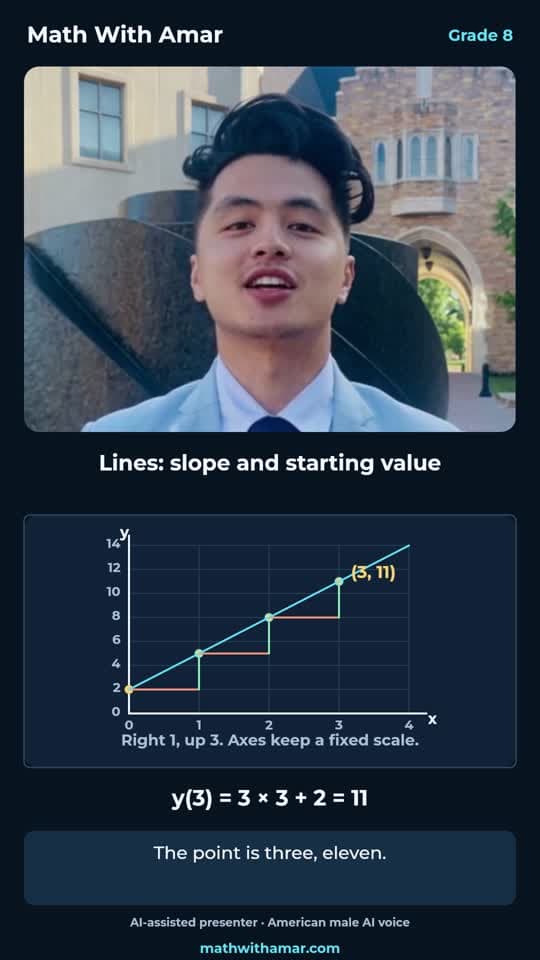
Watch, understand, then try it
Watch this grade’s teaching clips
Short explanations with animated examples, captions, and a full transcript. Each video opens beside its matching practice question so you can try the idea yourself.
Explore the complete written study sequence
1 short teaching clip is available above, each linked to its exact practice question. Every chapter below opens a written lesson with worked examples and practice. Full lesson recordings are being prepared; the interactive animations are available now.
Explore this level’s 100 interactive animationsFollow the learning sequence
Chapters and video availability
Each chapter follows an existing academy lesson. Numbers match the written study order; grade placement is a guide and school sequences may vary.
30 of 30 chapters · in study order
Chapter 1 · Algebra
Count factors to combine powers
Multiplication adds exponents of a common base, while division cancels matching nonzero factors.
Written lesson available · video pending
Study this chapterChapter 2 · Algebra
Distinguish a power of a power from a product
Raising a power to another integer power multiplies the exponents, and an outside power acts on every factor of a product.
Written lesson available · video pending
Study this chapterChapter 3 · Algebra
Extend exponent patterns through zero
For a nonzero base, the zero power is one and a negative integer exponent represents a reciprocal.
Written lesson available · video pending
Study this chapterChapter 4 · Algebra
Normalize very small numbers in scientific notation
Scientific notation writes a positive number as a coefficient from 1 up to but not including 10 times a power of ten.
Written lesson available · video pending
Study this chapterChapter 5 · Algebra
Align powers of ten before adding
Adding quantities in scientific notation requires expressing them with the same power of ten.
Written lesson available · video pending
Study this chapterChapter 6 · Algebra
Multiply and renormalize scientific notation
Products in scientific notation combine coefficients and powers separately, then restore the standard coefficient range.
Written lesson available · video pending
Study this chapterChapter 7 · Algebra
Distinguish a square root from solving a squared equation
The square-root symbol denotes the nonnegative root, while a positive squared equation has two real solutions.
Written lesson available · video pending
Study this chapterChapter 8 · Algebra
Use cube roots to recover a signed input
Cubing preserves a real number's sign, so a negative real number has one negative real cube root.
Written lesson available · video pending
Study this chapterChapter 9 · Algebra
Locate an irrational square root between decimals
Comparing squares gives reliable bounds on a positive square root without pretending a decimal approximation is exact.
Written lesson available · video pending
Study this chapterChapter 10 · Geometry
Recover a right triangle's missing leg
When the hypotenuse is known, the Pythagorean theorem finds a missing leg by subtraction of squares.
Written lesson available · video pending
Study this chapterChapter 11 · Geometry
Test whether three sides form a right triangle
The converse of the Pythagorean theorem recognizes a right triangle from a square-sum equality.
Written lesson available · video pending
Study this chapterChapter 12 · Geometry
Turn coordinate differences into a distance
The straight-line distance between two points is the hypotenuse formed by their horizontal and vertical differences.
Written lesson available · video pending
Study this chapterChapter 13 · Geometry
Translate a figure with one shared movement
A translation adds the same horizontal and vertical changes to every point, preserving shape, size, and orientation.
Written lesson available · video pending
Study this chapterChapter 14 · Geometry
Reflect points across coordinate axes
A reflection places each point the same perpendicular distance on the opposite side of a mirror line.
Written lesson available · video pending
Study this chapterChapter 15 · Geometry
Rotate a point through a quarter-turn
A quarter-turn about the origin exchanges coordinate roles with a sign determined by the rotation direction.
Written lesson available · video pending
Study this chapterChapter 16 · Geometry
Connect dilation with length and area factors
An origin-centred dilation multiplies coordinates by a scale factor; lengths scale by that factor and areas by its square.
Written lesson available · video pending
Study this chapterChapter 17 · Geometry
Establish congruence with a sequence of motions
Congruent figures can be matched by rigid motions that preserve every distance and angle.
Written lesson available · video pending
Study this chapterChapter 18 · Algebra
Explain constant slope with similar triangles
Right triangles drawn along one straight line have equal rise-to-run ratios because their corresponding angles match.
Written lesson available · video pending
Study this chapterChapter 19 · Algebra
Recover a linear rule from a table
A constant output change per input unit gives a linear rate, while substitution recovers the intercept.
Written lesson available · video pending
Study this chapterChapter 20 · Algebra
Solve an equation that needs distribution
Distributing and combining like terms can reveal the simpler equation hidden inside parentheses.
Written lesson available · video pending
Study this chapterChapter 21 · Algebra
Compare two expressions with the same unknown
When a variable appears on both sides, collecting its terms on one side reveals where two linear rules agree.
Written lesson available · video pending
Study this chapterChapter 22 · Algebra
Recognize equations with no solution or all real solutions
If variable terms cancel, the remaining statement tells whether an equation is impossible or true for every allowed input.
Written lesson available · video pending
Study this chapterChapter 23 · Algebra
Solve two linked conditions by substitution
A system's solution must satisfy both equations at once; substitution replaces a variable by an equal expression.
Written lesson available · video pending
Study this chapterChapter 24 · Algebra
Cancel one variable by adding equations
Adding valid equations produces another true equation and can eliminate a variable with opposite coefficients.
Written lesson available · video pending
Study this chapterChapter 25 · Algebra
Decide whether a relation is a function
A function assigns exactly one output to each input; different inputs are allowed to share an output.
Written lesson available · video pending
Study this chapterChapter 26 · Statistics
Read a scatter plot without claiming causation
A scatter plot can show direction, form, and unusual points, but an association alone does not identify a cause.
Written lesson available · video pending
Study this chapterChapter 27 · Statistics
Choose the denominator in a two-way table
A conditional relative frequency uses the size of the named group as its denominator, not automatically the whole sample.
Written lesson available · video pending
Study this chapterChapter 28 · Geometry
Build a cylinder from circular layers
A cylinder's volume is its circular base area multiplied by its perpendicular height.
Written lesson available · video pending
Study this chapterChapter 29 · Geometry
Compare a cone with its matching cylinder
A cone has one third of the volume of a cylinder with the same base area and perpendicular height.
Written lesson available · video pending
Study this chapterChapter 30 · Geometry
Connect sphere volume to cubic scaling
A sphere's volume is 4πr³/3, so changing its radius changes its volume by a cubic factor.
Written lesson available · video pending
Study this chapter