A 5% hill is not a 5° hill
SVG originals & image description
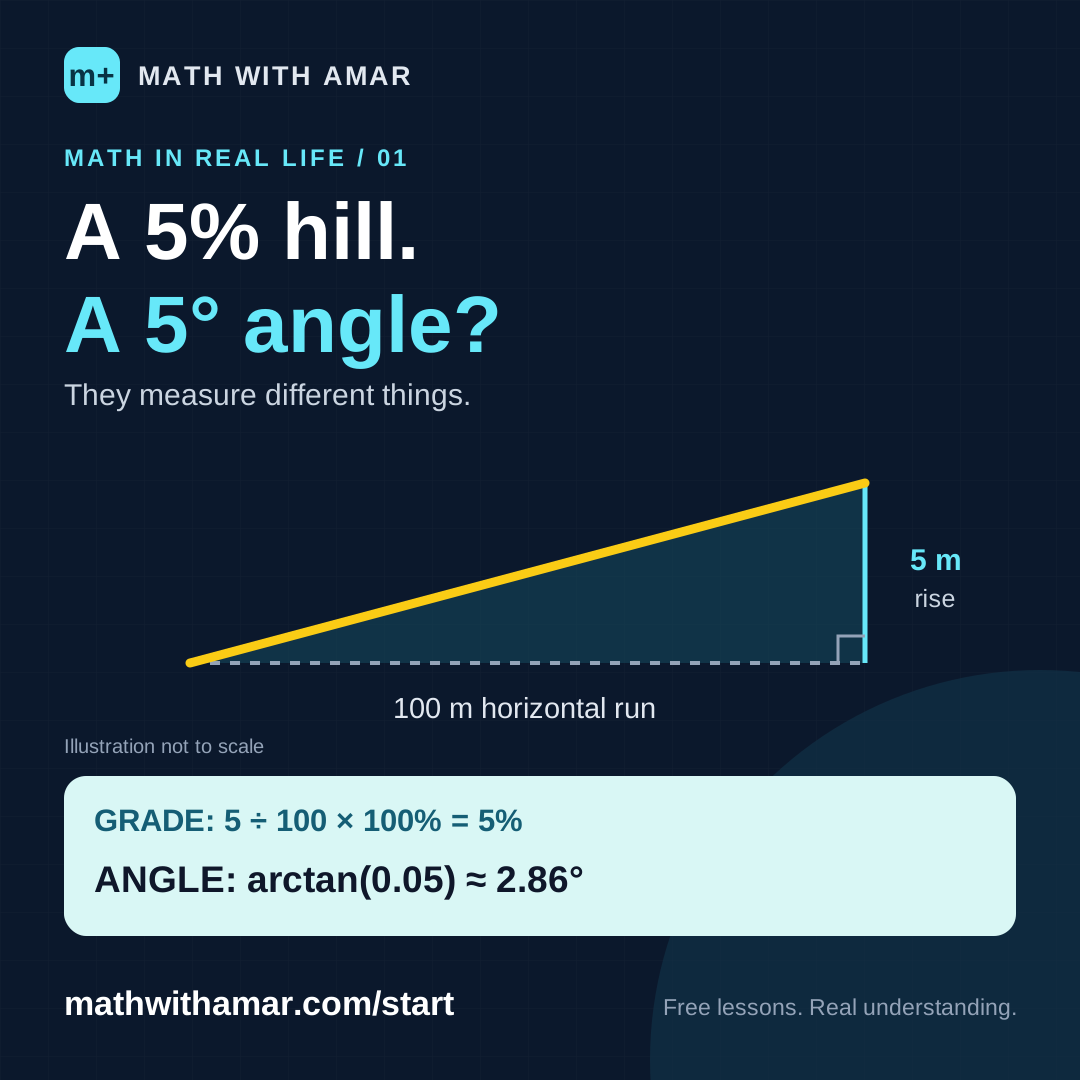
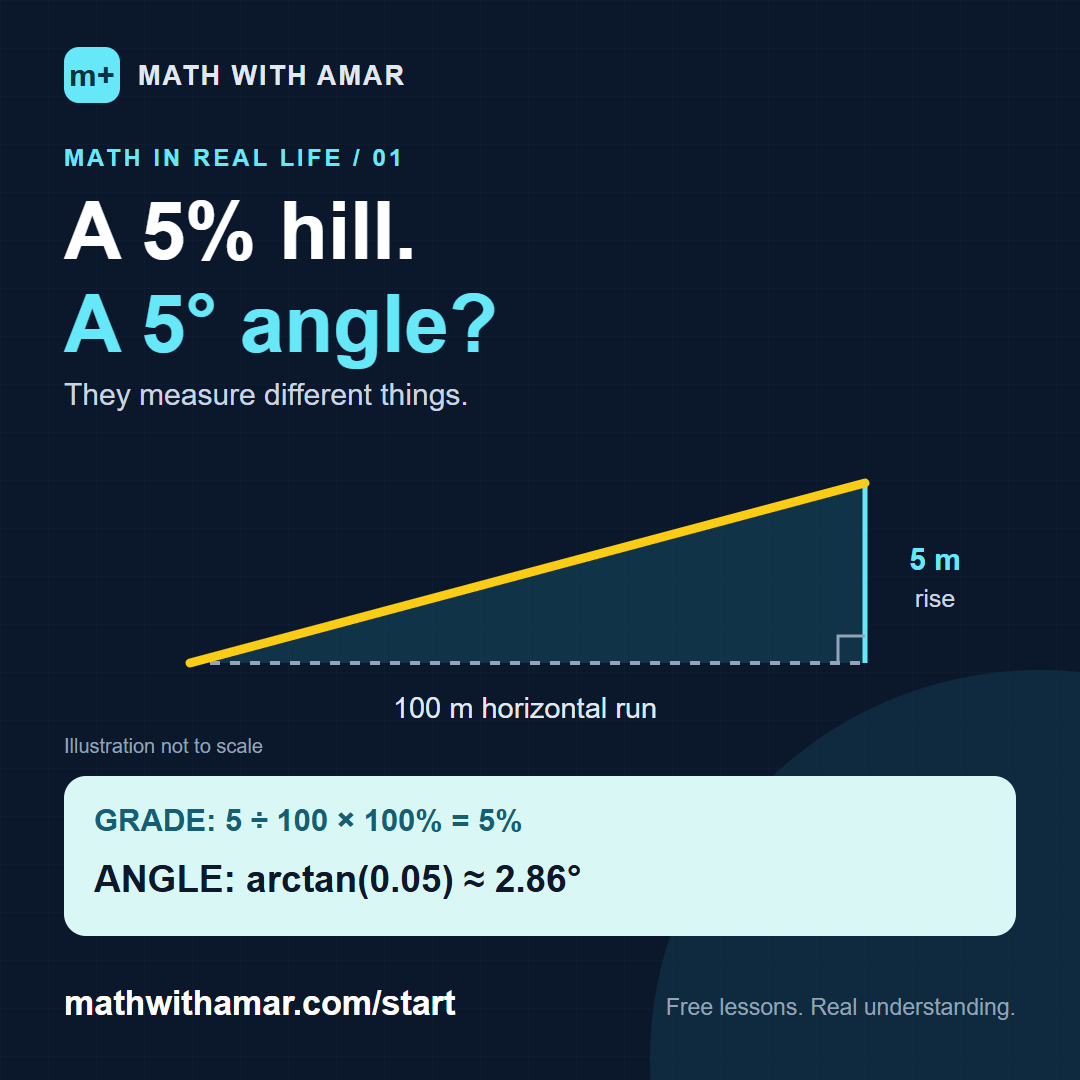
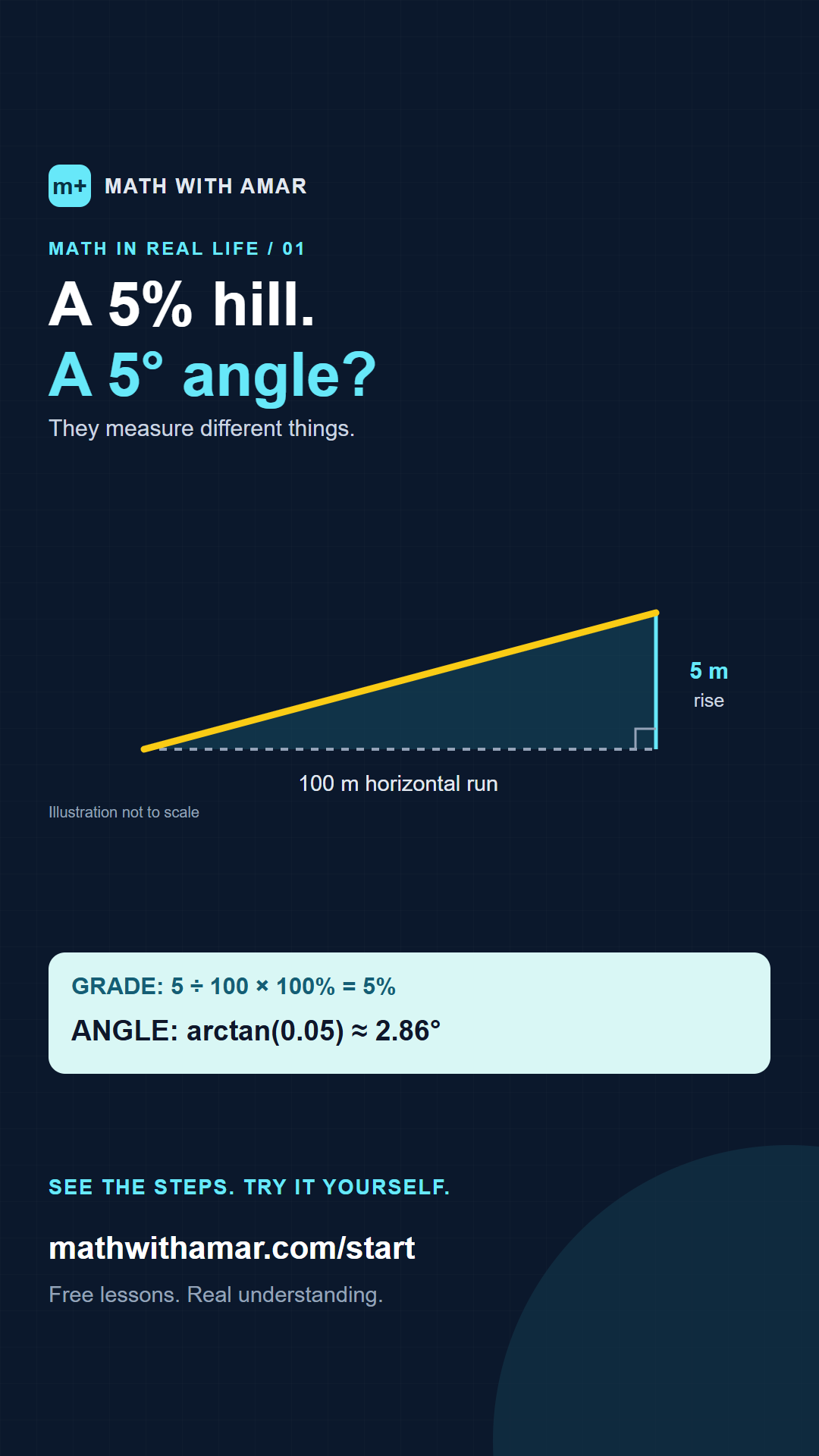
A 5 percent road grade rises 5 metres over 100 horizontal metres. Its angle is about 2.86 degrees. Diagram not to scale.
Teach something worth sharing
The Math With Amar Academy brand kit and a two-week teaching campaign. One portrait, useful examples, and a welcoming path from a short video to real practice.
Prepare here, then publish from the accounts you create. Social profiles and posts are not created automatically.

Amar’s own photograph, edited with AI for the academy. Use the same portrait across the official profiles you create.
The academy brand kit
Understand the idea. See the steps. Try it yourself. Build every profile around helpful teaching and a direct route into free practice.
Download brand copy + all 14 teaching postsSet up the four profiles →Before your first post
Create or open your own TikTok, YouTube, Facebook, and Instagram profiles, then use the copy below. The suggested handle is a proposal; its availability has not been checked. This page does not claim that any social account is already live.
Check the proposed handle inside each platform. If it is unavailable, choose a consistent variation you can own. Upload the portrait above and keep the face centered in each circular crop.
Select the platform below, copy its academy link, and place it in the profile’s website or links field when available. Test the saved link on your phone.
Record a short introduction: who you are, what one lesson feels like, and where to choose a level. Pin it if your platform supports pinned posts. Avoid promises about grades or guaranteed results.
Start with day one below, or choose the post that fits your audience. Upload your own original video, add captions, and preview the full post. Keep student identities and private work out of the recording.
Send people directly to the academy’s level picker. The fixed labels identify the campaign; they do not guarantee that a visit can be attributed. Ordinary analytics shows pages and available referrers. Vercel’s UTM-specific filters require a paid analytics tier.
Add the website link if your account has a Website field. Otherwise show mathwithamar.com/learn on screen and in your profile text.
Made to explain, made to share
Download a square image for a feed post or a vertical image for a story or video cover. The answer is included. PNG files are ready to upload; SVG files stay sharp when resized.
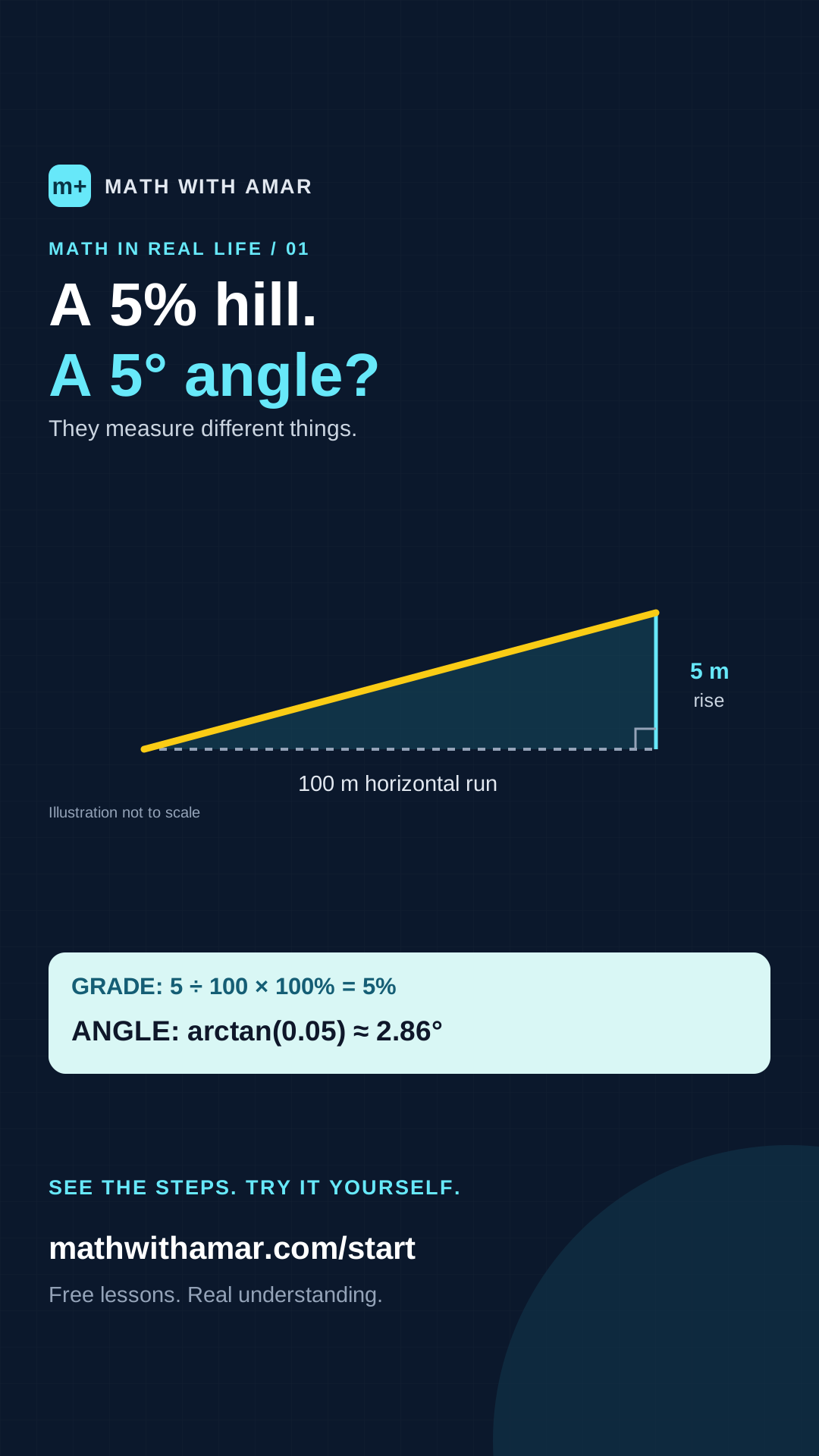
A 5 percent road grade rises 5 metres over 100 horizontal metres. Its angle is about 2.86 degrees. Diagram not to scale.
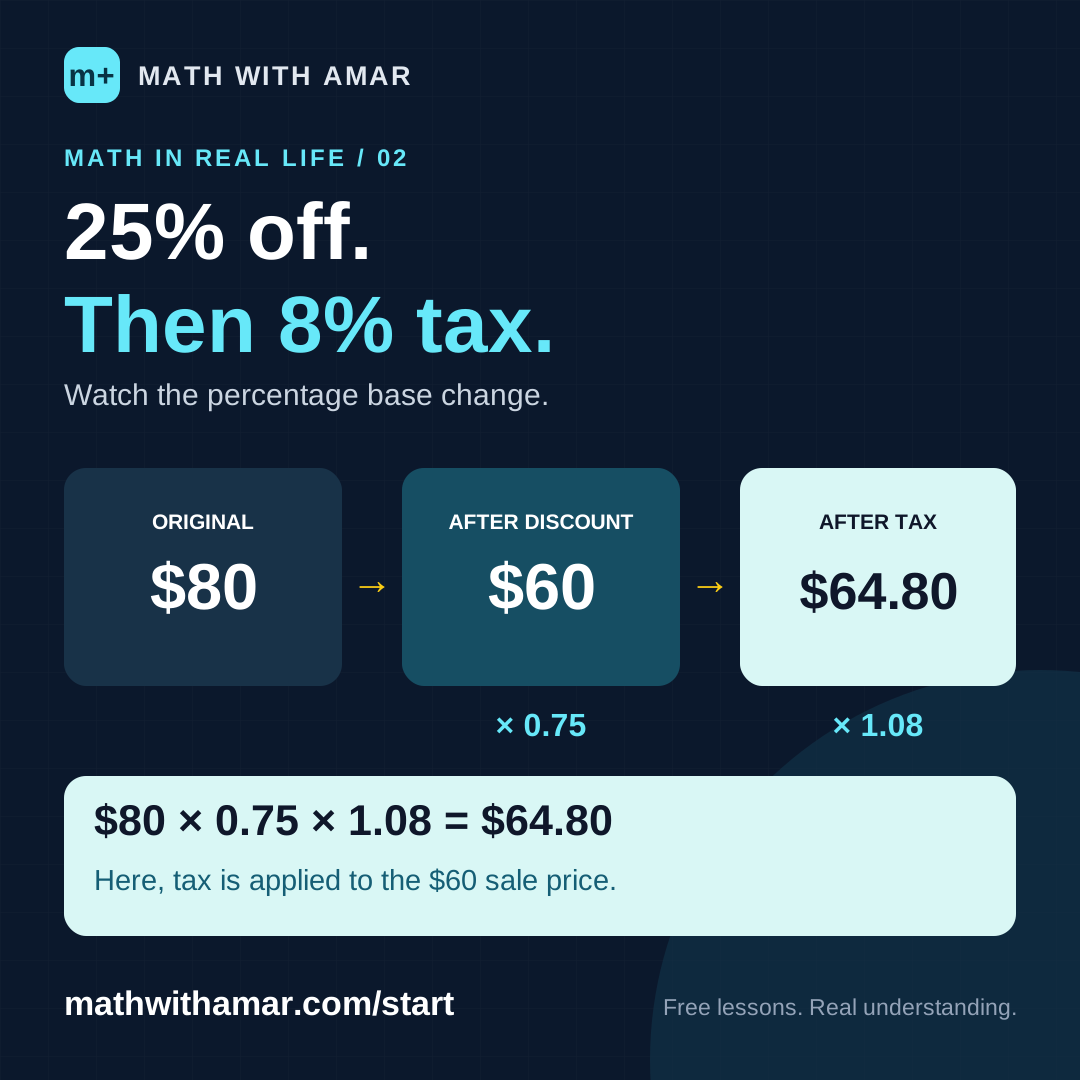
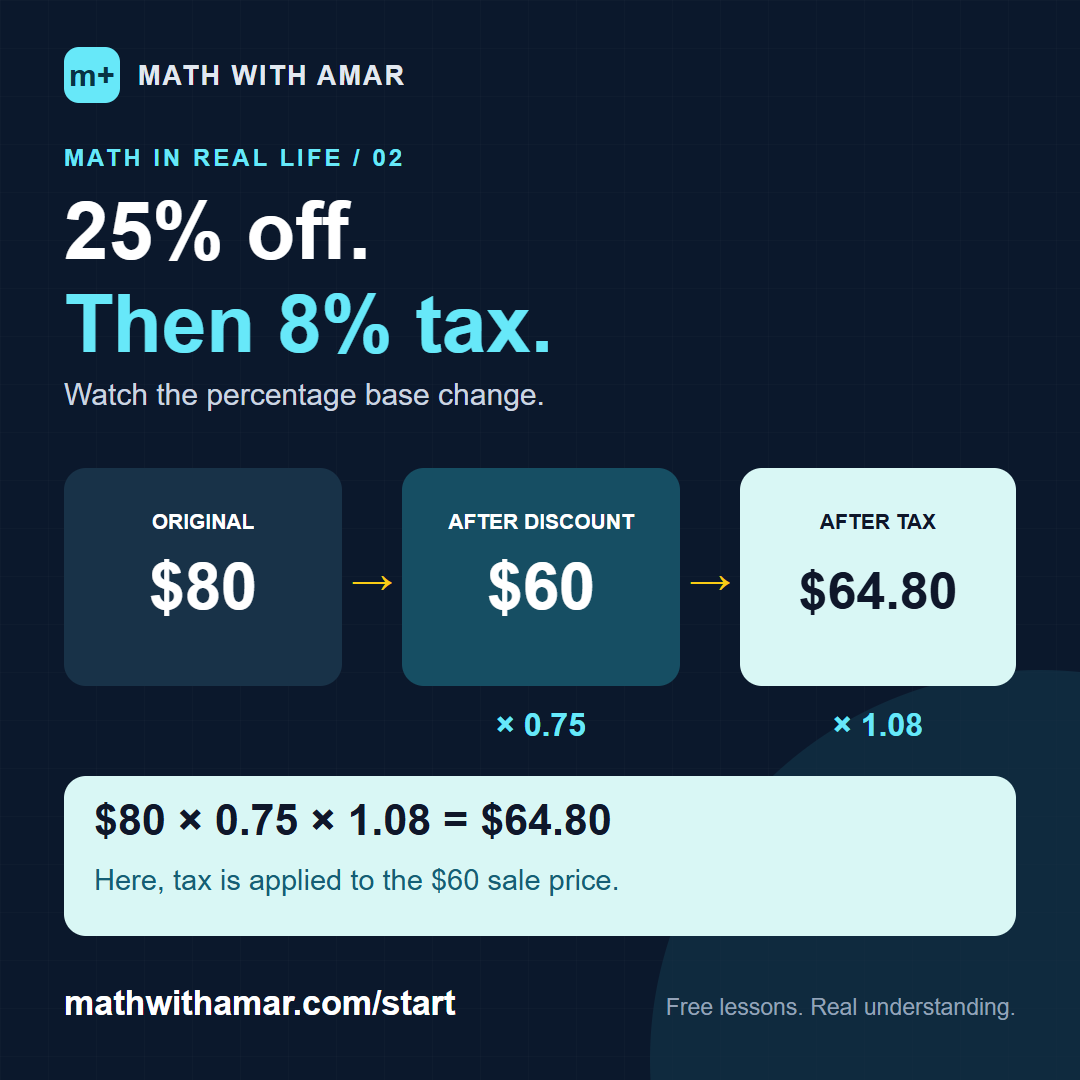
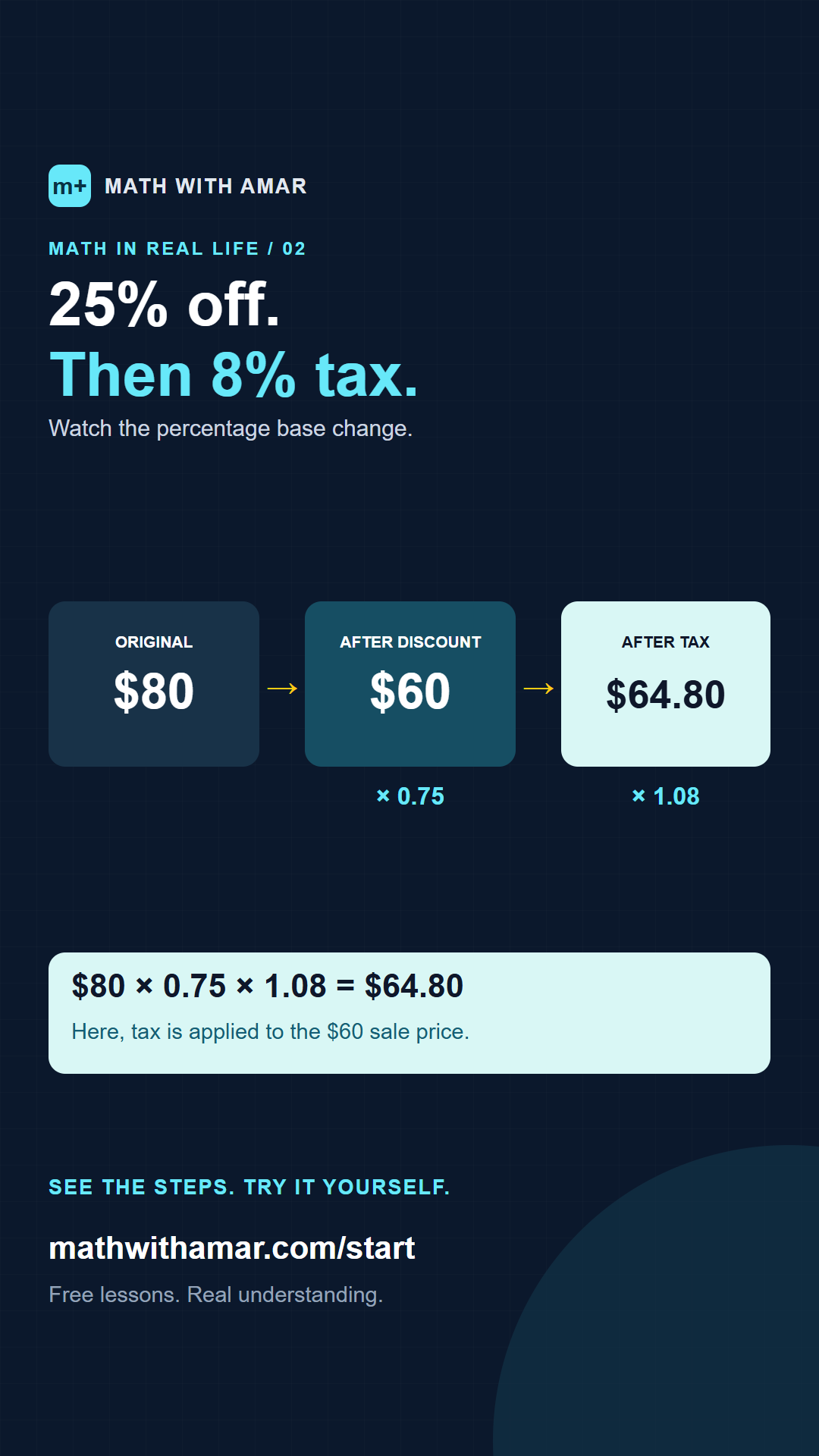
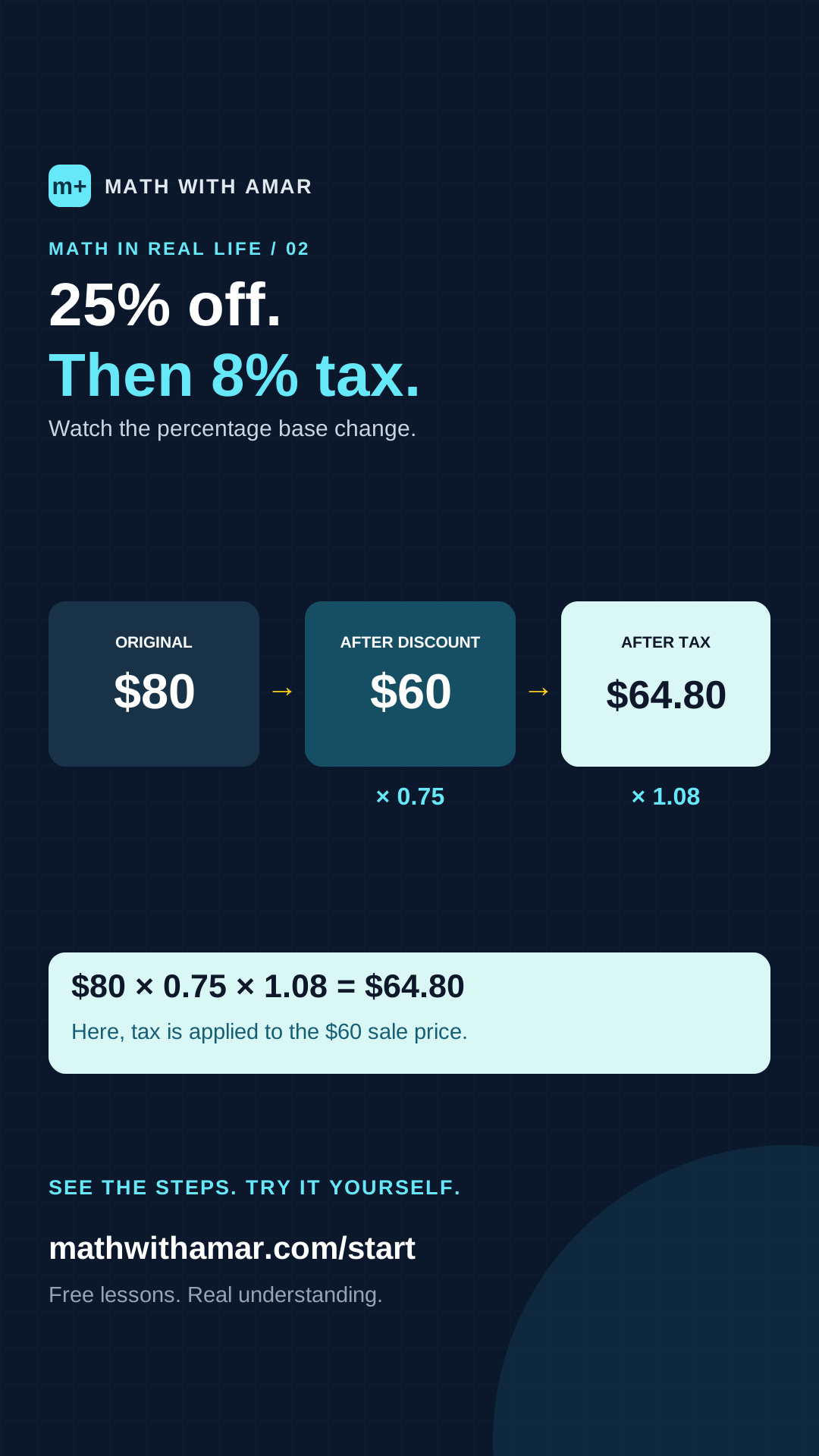
An 80 dollar item with 25 percent off costs 60 dollars. Adding 8 percent tax to the sale price gives 64 dollars and 80 cents.
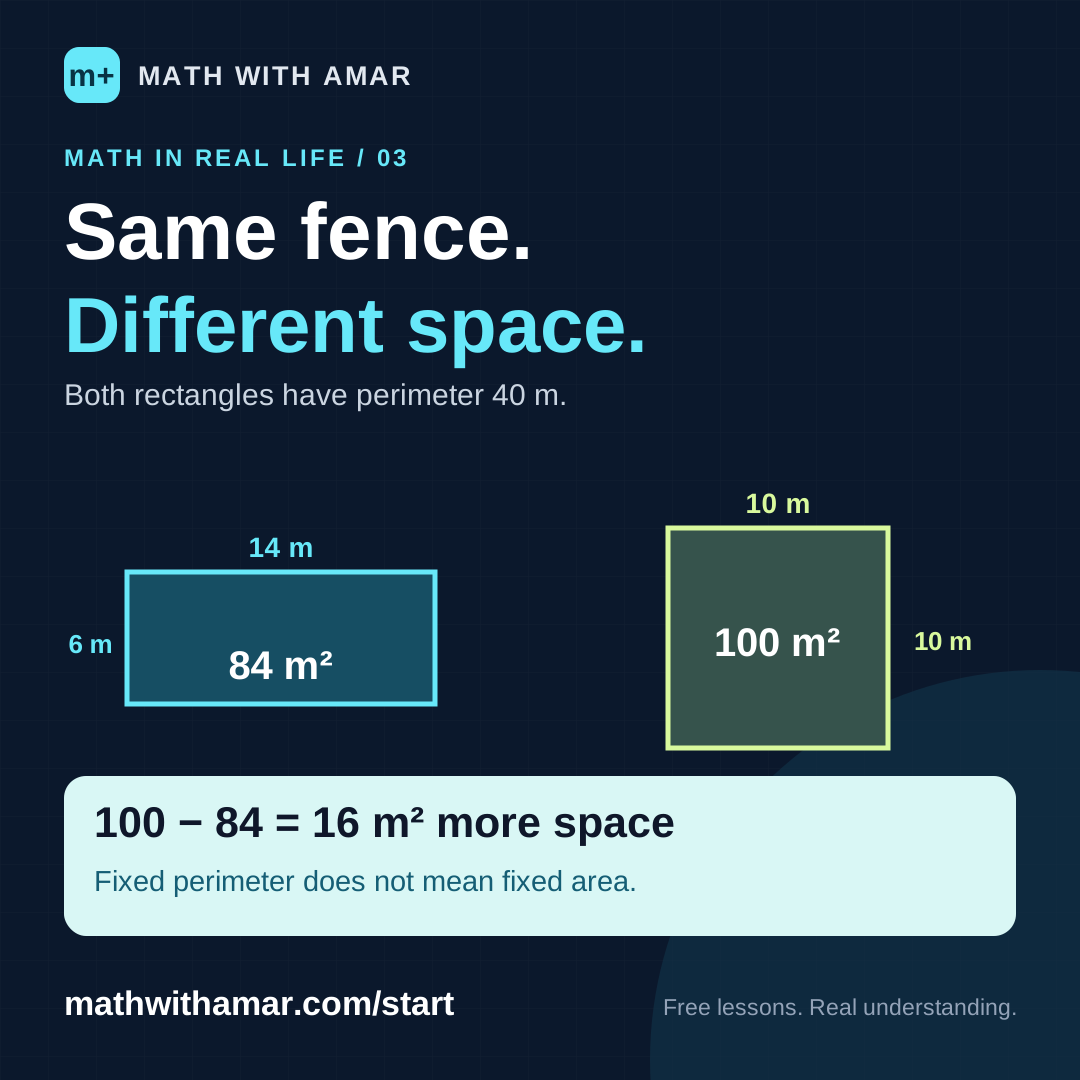
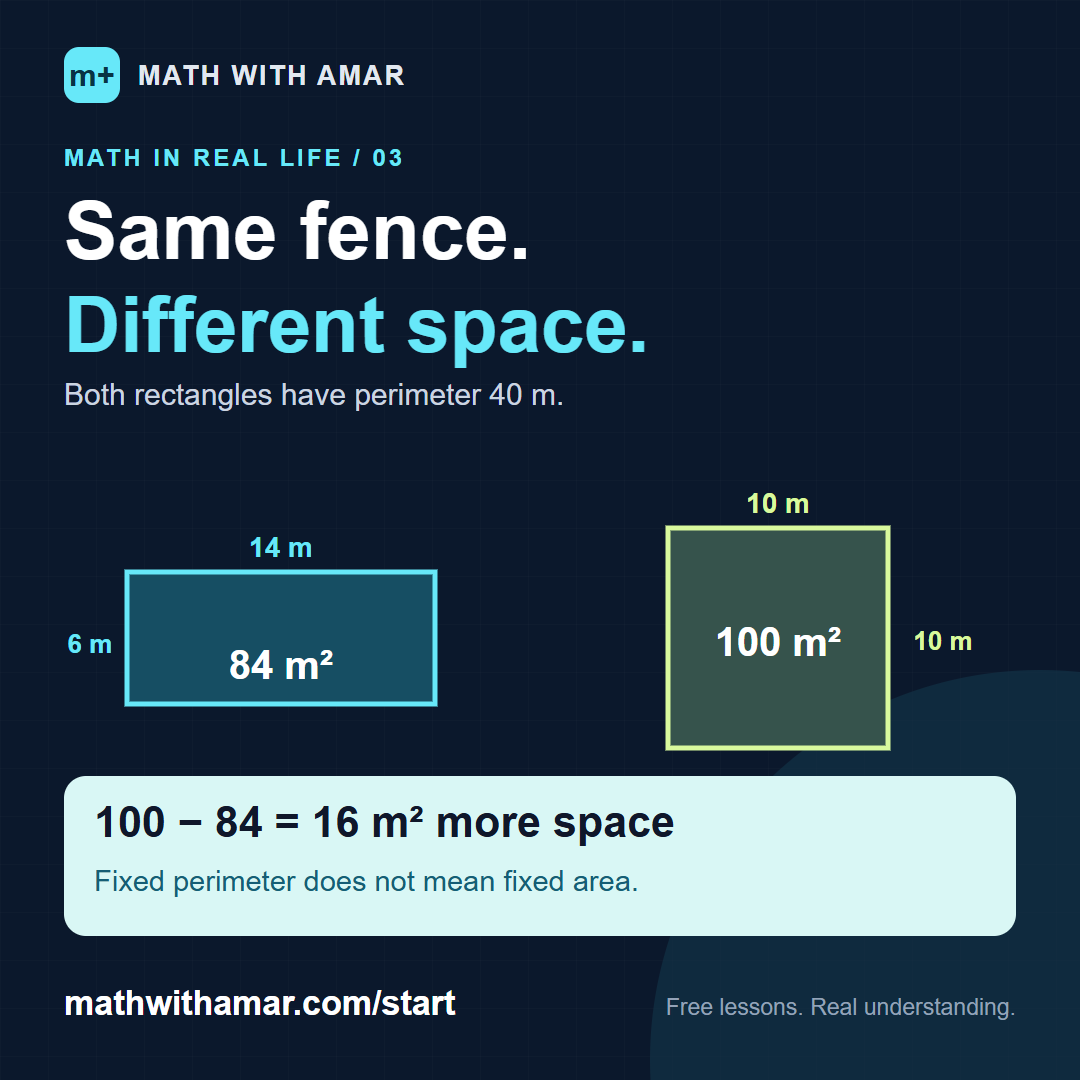
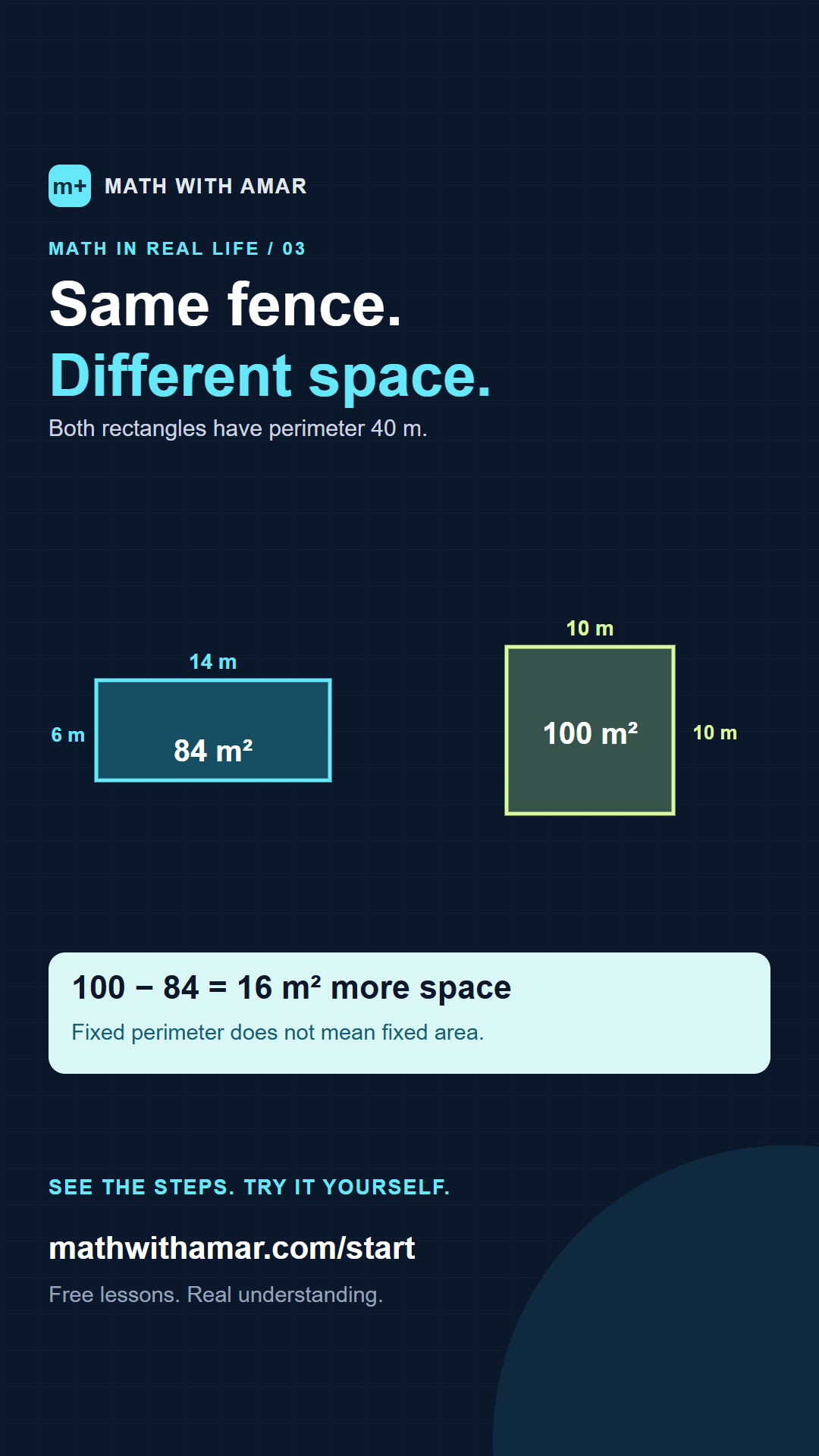
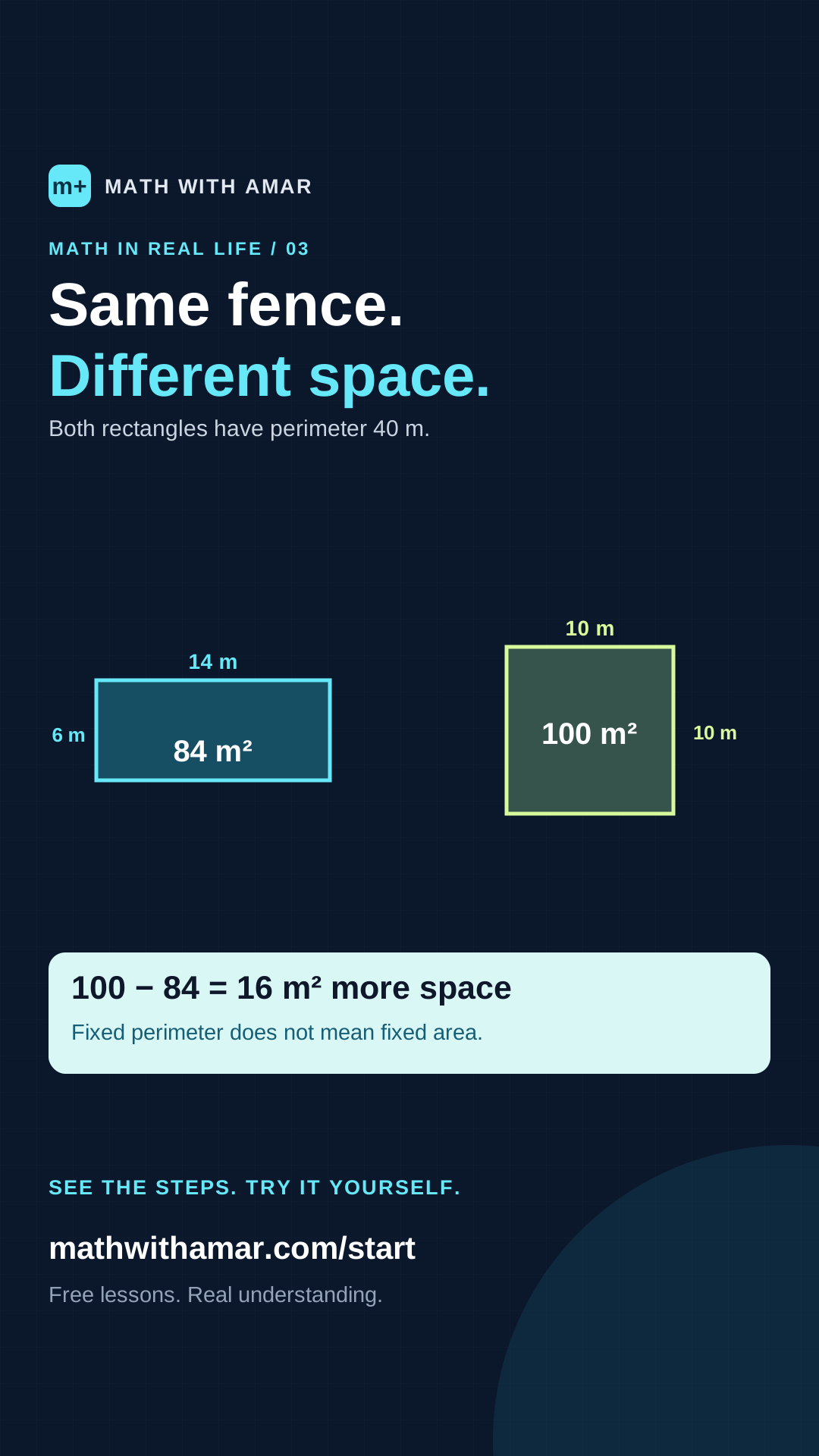
Two rectangles both have a perimeter of 40 metres. A 6 by 14 metre rectangle has area 84 square metres. A 10 by 10 metre square has area 100 square metres.
Fourteen days of useful math
Each post includes a complete spoken explanation and a caption for TikTok. Choose the channel above before copying. Each day has an audience level, a visual plan, a full explanation, and a practice destination. Suggested durations are filming estimates.
Download the whole launch kitDay 1 · 20–30 second overhead demonstration
Grade 1 · for families
Show: Use large counters on a plain mat. Touch each once, move the same seven apart, and display 4 + 3 = 7. Keep the full set visible throughout.
Here are four counters and three more. Touch each counter once: one, two, three, four, five, six, seven. Now spread them farther apart. Nothing was added or removed, so there are still seven. The last counting word tells how many objects we have. Families can try the count-once lesson together at Math With Amar Academy.
If I spread these seven counters out, do I have more? 4 counters + 3 counters = 7. Moving them changes the spacing, not the number. Try touching each object exactly once, then rearranging the same collection. Families: open the free lesson and try the next example together. Try the free practice through the website link on the profile, or type mathwithamar.com/learn and search for this topic. Lesson: https://www.mathwithamar.com/learn/g1-count-once?utm_source=tiktok&utm_medium=organic_social&utm_campaign=academy-launch #MathWithAmar #EarlyMath #LearningTogether
Publish step: Introduce the academy with a useful demonstration. Address parents and caregivers; do not ask young children to create social accounts.
Day 2 · 25–35 second place-value board
Grade 2 · place value
Show: Label H, T, O in words as well as letters. Put 5, 0, 7 below them, then compare 57 aligned to the right. Show 500 versus 50.
Write three columns: hundreds, tens, ones. Five hundred seven has five hundreds, no tens, and seven ones. That is five hundred plus zero plus seven. The zero keeps the five in the hundreds column. Remove it from the written number and fifty-seven has five tens instead. Try building another number with an empty place in the free lesson.
Why is 507 different from 57 if zero means none? 507 = 500 + 0 + 7. In 57, the 5 means 50; in 507 it means 500. A zero can hold an empty place without making the other digits move. Try the worked example and practice questions. Try the free practice through the website link on the profile, or type mathwithamar.com/learn and search for this topic. Lesson: https://www.mathwithamar.com/learn/g2-expanded-form?utm_source=tiktok&utm_medium=organic_social&utm_campaign=academy-launch #MathWithAmar #PlaceValue #PrimaryMath
Publish step: Use the same portrait and display name as day one. Add captions for the spoken place names.
Day 3 · 25–35 second dot-array demonstration
Grade 3 · multiplication
Show: Use a real sheet with a 4-by-7 dot array. Label rows and dots per row, rotate the sheet, and relabel. Avoid an animation that accidentally adds dots.
Draw four rows of seven dots. That is twenty-eight dots. Turn the paper a quarter turn. Now you can see seven rows of four. The same dots are still there; we did not add or remove any. This shows why four times seven equals seven times four. Make your own array and try the practice in the lesson.
Can you prove 4 × 7 equals 7 × 4 without counting twice? 4 rows × 7 dots = 28 dots. Turn the same array: 7 rows × 4 dots = 28. The total stays the same because the objects stay the same. Draw another rectangle of dots and test the idea. Try the free practice through the website link on the profile, or type mathwithamar.com/learn and search for this topic. Lesson: https://www.mathwithamar.com/learn/g3-turn-array?utm_source=tiktok&utm_medium=organic_social&utm_campaign=academy-launch #MathWithAmar #Multiplication #VisualMath
Publish step: Pause briefly before turning the array so viewers can predict the new row count. Link to practice, not an answer hidden in another post.
Day 4 · 30–40 second shaded-strip explanation
Grade 4 · fractions
Show: Use one rectangle throughout. Add eight equal divisions, shade six, then place a bold outline around each pair. Keep the outer boundary fixed.
Split one strip into eight equal pieces and shade six. Now group the pieces in pairs. The whole strip has four pairs, and three pairs are shaded. Each pair is one fourth of the original whole, so six eighths is three fourths. The shaded area has not changed; the unit has. Try another regrouping in the free lesson.
How can six eighths become three fourths without losing anything? 6/8 = 3/4: divide both the selected-piece count and the total-piece count by 2. Keep the same whole. Larger pieces need fewer pieces to describe the same shaded amount. Try the next fraction in the lesson. Try the free practice through the website link on the profile, or type mathwithamar.com/learn and search for this topic. Lesson: https://www.mathwithamar.com/learn/g4-simplify-fractions?utm_source=tiktok&utm_medium=organic_social&utm_campaign=academy-launch #MathWithAmar #Fractions #VisualLearning
Publish step: Offer an image description in the caption so the fraction explanation also works without relying on color.
Day 5 · 30–40 second ratio-table explanation
Grade 6 · ratios
Show: Draw a two-column ratio table: Blue 2, 8; White 5, 20. Put ×4 beside both columns. Use labeled measures so the model is clear.
Our model mix has two measures of blue for five of white. Twenty white is four times five, so multiply the blue by four too: two times four is eight. The matching pair is eight blue and twenty white. Adding fifteen to both amounts would change the ratio. Try extending the table in the free lesson.
Two measures blue, five white. What if the white becomes twenty? 2:5 scales to 8:20 because both quantities are multiplied by 4. Equal scaling preserves the ratio; equal addition generally does not. This is a mathematical mixing model. Extend the table in the lesson. Try the free practice through the website link on the profile, or type mathwithamar.com/learn and search for this topic. Lesson: https://www.mathwithamar.com/learn/g6-equivalent-ratio-table?utm_source=tiktok&utm_medium=organic_social&utm_campaign=academy-launch #MathWithAmar #Ratios #MiddleSchoolMath
Publish step: Answer one common mathematical misconception in the caption. Keep responses general and avoid collecting student details.
Day 6 · 25–35 second video; road-grade square or story card
High school · slope and angles
Show: Draw a road triangle. Label 5 m rise and 100 m horizontal run. Pause on the question, then reveal 2.86°. Say the sketch is not to scale.
A 5% road grade means a rise of 5 metres for every 100 horizontal metres. That ratio is 5 divided by 100, or 0.05. To get the angle, use inverse tangent: arctan of 0.05 is about 2.86 degrees. A percent grade and an angle measure different things. Try the worked example at Math With Amar.
Does a 5% road grade mean a 5-degree hill? A 5% road grade rises 5 m for every 100 horizontal metres. Its angle is arctan(0.05), about 2.86° — not 5°. Sketch a triangle and label the horizontal run first. Free explanation and practice at Math With Amar. Try the free practice through the website link on the profile, or type mathwithamar.com/learn and search for this topic. Lesson: https://www.mathwithamar.com/learn/slope-and-road-grade?utm_source=tiktok&utm_medium=organic_social&utm_campaign=academy-launch #MathWithAmar #MathInRealLife #Algebra
Publish step: Set the profile website link to the matching platform link above; publish the full explanation and save a baseline of views and website visits.
Day 7 · 25–35 second video; sale-math square or story card
Grades 6–8 · percentages
Show: Write $80 → $60 → $64.80 on separate cards. Under each arrow show ×0.75, then ×1.08. State the assumed tax order.
Start with eighty dollars. Taking off twenty-five percent leaves seventy-five percent, so eighty times 0.75 is sixty dollars. In this example, the eight-percent tax applies to the sale price. Sixty times 1.08 is sixty-four dollars and eighty cents. The percentage base changes after the discount. Work through another example at Math With Amar.
$80, then 25% off, then 8% tax. What do you pay? $80 × 0.75 × 1.08 = $64.80. This example applies 8% tax after the 25% discount, so the tax is calculated on $60. The lesson: name the base before using a percentage. Try the free worked example. Try the free practice through the website link on the profile, or type mathwithamar.com/learn and search for this topic. Lesson: https://www.mathwithamar.com/learn/percentages-discounts-and-tax?utm_source=tiktok&utm_medium=organic_social&utm_campaign=academy-launch #MathWithAmar #Percentages #EverydayMath
Publish step: Post the story graphic alongside the video. Record which question viewers ask about the changing percentage base.