Math With AmarA C A D E M Y

A place to build understanding

A clear path.
A stronger foundation.
Your next idea.

Start with the mathematics you know, then build on it one lesson at a time. Choose a study level, work through an explained example, and practice until you can tell someone why the method works.

578 free lessons 280 math terms No account needed to learn

Mathematics learning materials for exploring numbers, shapes, and measurement

Make the idea visible.

Use objects, sketches, graphs, and words alongside the calculation. Understanding grows when the representations connect.

A question. A worked solution. A moving example.

Explore 10,000 guided practice chapters.

Find a new mathematical scenario from Grade 1 to graduate study. Try the question, compare your reasoning, and control its animated example. Search by grade or topic and take one chapter at a time.

Open the practice library

10,000 distinct practice scenarios using reusable math models. Filmed teaching videos are a separate collection.

Four pathways. One connected subject.

Where would you like to begin?

Choose a familiar grade or explore a topic that interests you. Each pathway explains what you will study and what to review first. Grade labels are guides: school sequences differ, and you can move between levels whenever you need to.

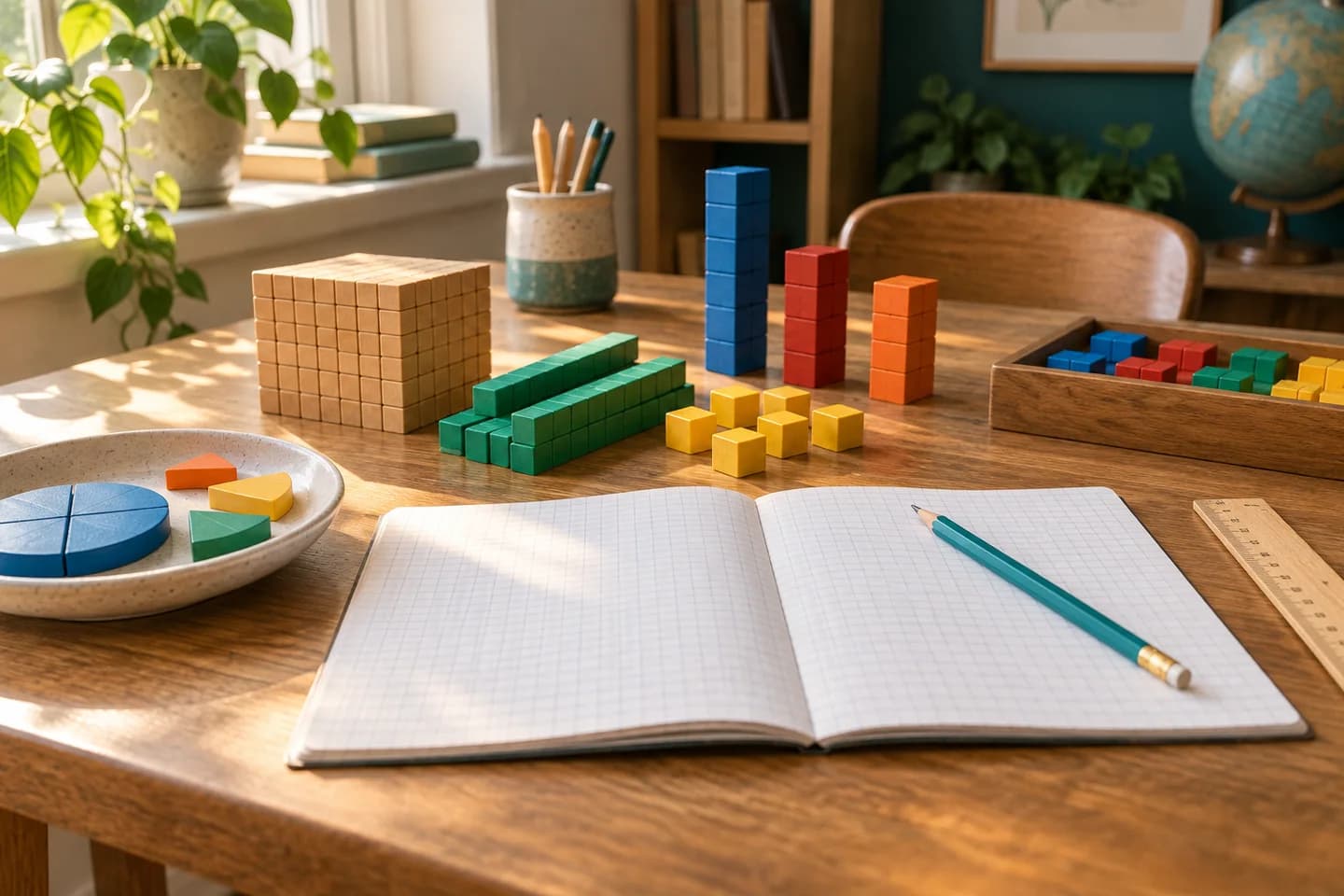
Hands-on mathematics materials for exploring numbers, shapes, and measurement01 · Grades 1–6

Primary mathematics

Build your foundations

Make numbers meaningful with objects, pictures, and everyday questions. Move from counting and place value to fractions, measurement, and the first steps of algebra, with time to explain how each answer works.

  • Number sense and arithmetic
  • Fractions and measurement
  • Patterns and early problem solving
What should I know first?

Start with the grade that feels comfortable. A younger learner can work with an adult, use counters or paper, and read each question aloud.

Suggested first lessonCount every object once
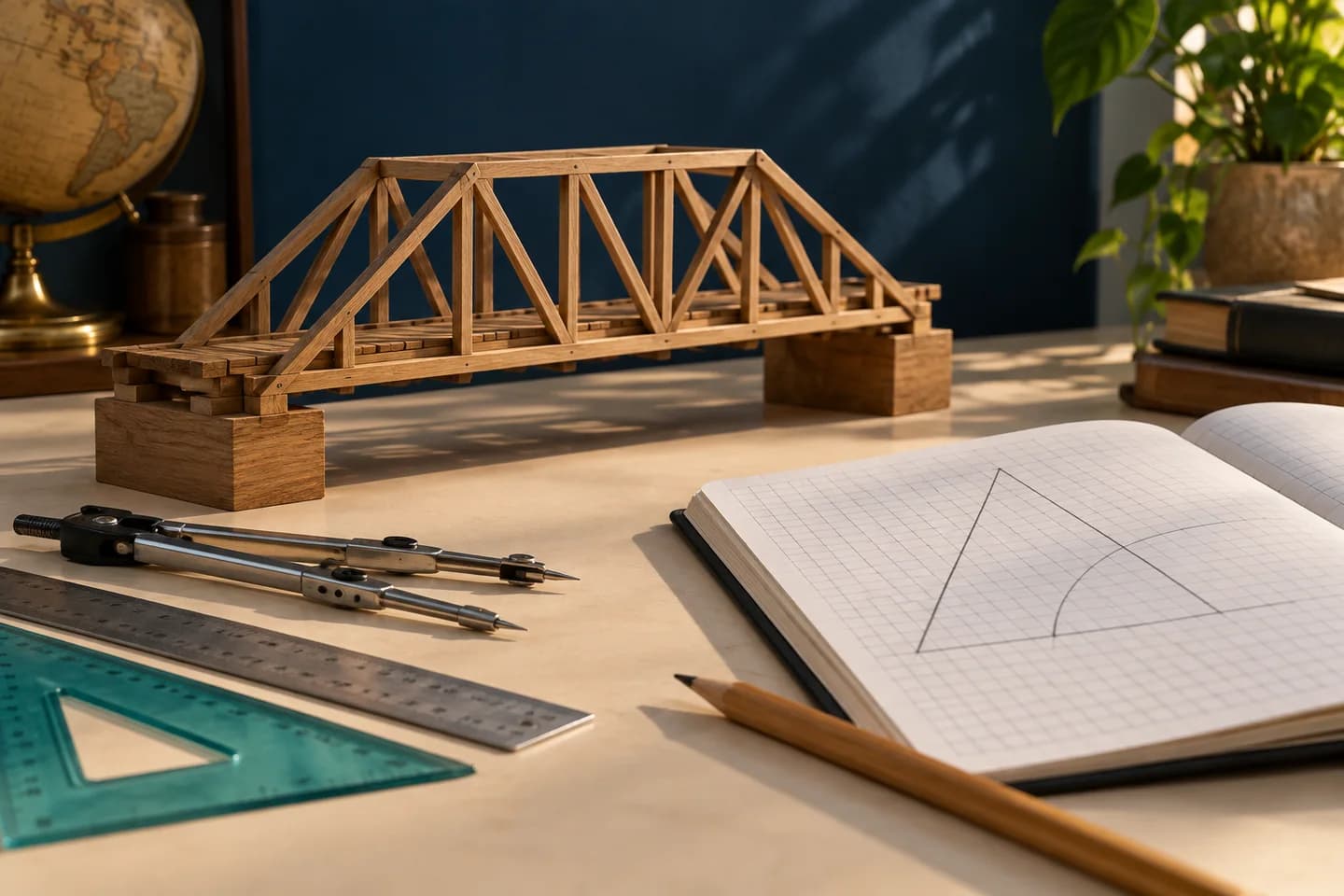
A collection of concrete mathematics tools for building mathematical understanding02 · Grades 7–8

Middle school mathematics

Connect numbers to ideas

Use fractions, ratios, and signed numbers to describe real situations. Then connect equations, graphs, geometry, and data so you can choose a method and explain what the result means.

  • Ratios, rates, and proportional thinking
  • Equations and coordinate graphs
  • Geometry, probability, and data
What should I know first?

Be comfortable with whole-number arithmetic and simple fractions. Revisit Grade 6 when ratios, negative numbers, or the meaning of a variable still feel unfamiliar.

Suggested first lessonFind a rate when both quantities are fractions
A mathematics study workspace connecting graphs, geometry, and problem solving03 · Grades 9–12

High school mathematics

Develop confident reasoning

Bring algebra, geometry, and functions together to tackle richer problems. Develop trigonometric reasoning, interpret statistical evidence, and explore the rates and accumulation that lead into calculus.

  • Algebra, functions, and geometric reasoning
  • Trigonometry and mathematical models
  • Statistics and introductory calculus
What should I know first?

Begin with fluency in fractions, equations, and coordinate graphs. Check each lesson’s prerequisites; calculus and later statistics assume more background than the early algebra lessons.

Suggested first lessonExplain exponent laws by matching factors
An advanced mathematics workspace with geometric models and research notes04 · Undergraduate & graduate

University and beyond

Explore deeper mathematics

Learn to state assumptions, build arguments, and connect abstract ideas to useful models. Explore selected topics in linear algebra, analysis, probability, geometry, and fluid mathematics through focused worked examples.

  • Proof, structure, and linear algebra
  • Analysis, geometry, and probability
  • Differential equations and fluid models
What should I know first?

These are introductions to selected topics, not complete degree courses. Start with the stated prerequisites, and review proof techniques, calculus, or linear algebra before entering a topic that uses them.

Suggested first lessonWhy the order of quantifiers changes a claim

A practical study routine

Read it. Work it. Explain it.

One focused lesson is a useful start. Keep paper nearby and take the time you need; the estimated lesson length is a guide, not a deadline.

  1. STEP 1

    Choose a comfortable start

    Read the goals and prerequisites. If an idea is unfamiliar, review it first or open the dictionary. You do not need to finish a whole grade before exploring another subject.

  2. STEP 2

    Work alongside the example

    Pause after each step and try to predict the next one. Write down what the quantities mean, why the operation is allowed, and how the answer connects to the question.

  3. STEP 3

    Practice and reflect

    Attempt the practice before opening a hint. Check the explanation, correct your reasoning, and explain the idea in your own words before marking the lesson complete.

Prefer to follow a subject?

Find the connections across grades.

Subject pathways bring related ideas together at different levels. Use the grade and difficulty filters inside each pathway to find material that matches your background.

An advanced mathematics workspace with geometric models and research notes

A guided introduction to fluid mathematics

From flowing water to Navier–Stokes.

Begin with vector fields, viscosity, and differential equations. Follow an 18-lesson guide to the mathematical background, then read a dated, sourced explanation of the 2026 announcement and the limits of what it establishes.

Explore the fluid guide

The complete lesson library

Find the idea you want to understand.

Search a topic, choose a grade, or narrow the library by subject. Every lesson includes a worked example and practice with hints and explanations.

Open the visual lab

Showing 12 of 578 matching lessons · All free

Hands-on mathematics materials for exploring numbers, shapes, and measurementAlgebra

Grade 1 · Foundations 6 min

Count every object once

Match one counting word to each object.

Read, practice, and reflect
Hands-on mathematics materials for exploring numbers, shapes, and measurementAlgebra

Grade 1 · Foundations 6 min

Zero means none

Use zero to describe an empty group.

Read, practice, and reflect
Hands-on mathematics materials for exploring numbers, shapes, and measurementAlgebra

Grade 1 · Foundations 6 min

One more and one less

Find neighbors of a number by moving one counting step.

Read, practice, and reflect
Hands-on mathematics materials for exploring numbers, shapes, and measurementAlgebra

Grade 1 · Foundations 6 min

Compare groups by matching

Decide which group has more using pairs.

Read, practice, and reflect
Hands-on mathematics materials for exploring numbers, shapes, and measurementAlgebra

Grade 1 · Foundations 6 min

Put three counts in order

Order three whole numbers from least to greatest.

Read, practice, and reflect
Hands-on mathematics materials for exploring numbers, shapes, and measurementAlgebra

Grade 1 · Foundations 6 min

Positions in a line

Distinguish an object's position from a group's size.

Read, practice, and reflect
Hands-on mathematics materials for exploring numbers, shapes, and measurementAlgebra

Grade 1 · Foundations 6 min

See five and some more

Use a group of five to recognize a total without recounting.

Read, practice, and reflect
Hands-on mathematics materials for exploring numbers, shapes, and measurementAlgebra

Grade 1 · Foundations 6 min

Find the missing part of ten

Compose ten from two smaller groups.

Read, practice, and reflect
Hands-on mathematics materials for exploring numbers, shapes, and measurementAlgebra

Grade 1 · Foundations 6 min

Teen numbers are ten and ones

Build a teen number from one ten and extra ones.

Read, practice, and reflect
Hands-on mathematics materials for exploring numbers, shapes, and measurementAlgebra

Grade 1 · Foundations 6 min

Addition joins two groups

Represent a joining story with an addition equation.

Read, practice, and reflect
Hands-on mathematics materials for exploring numbers, shapes, and measurementAlgebra

Grade 1 · Foundations 6 min

Count on from the larger part

Add a small number by counting forward from a known amount.

Read, practice, and reflect
Hands-on mathematics materials for exploring numbers, shapes, and measurementAlgebra

Grade 1 · Foundations 6 min

Build equal-pair doubles

Recognize a double as two equal addends.

Read, practice, and reflect