
Math With Amar · Guided practice
10,000 ways to practice.
One idea at a time.
Each chapter gives you a distinct mathematical scenario: one question to attempt, a hint, a worked solution, and an animated example you can control.
10,000 questions · 10,000 animated scenarios · 14 study levels
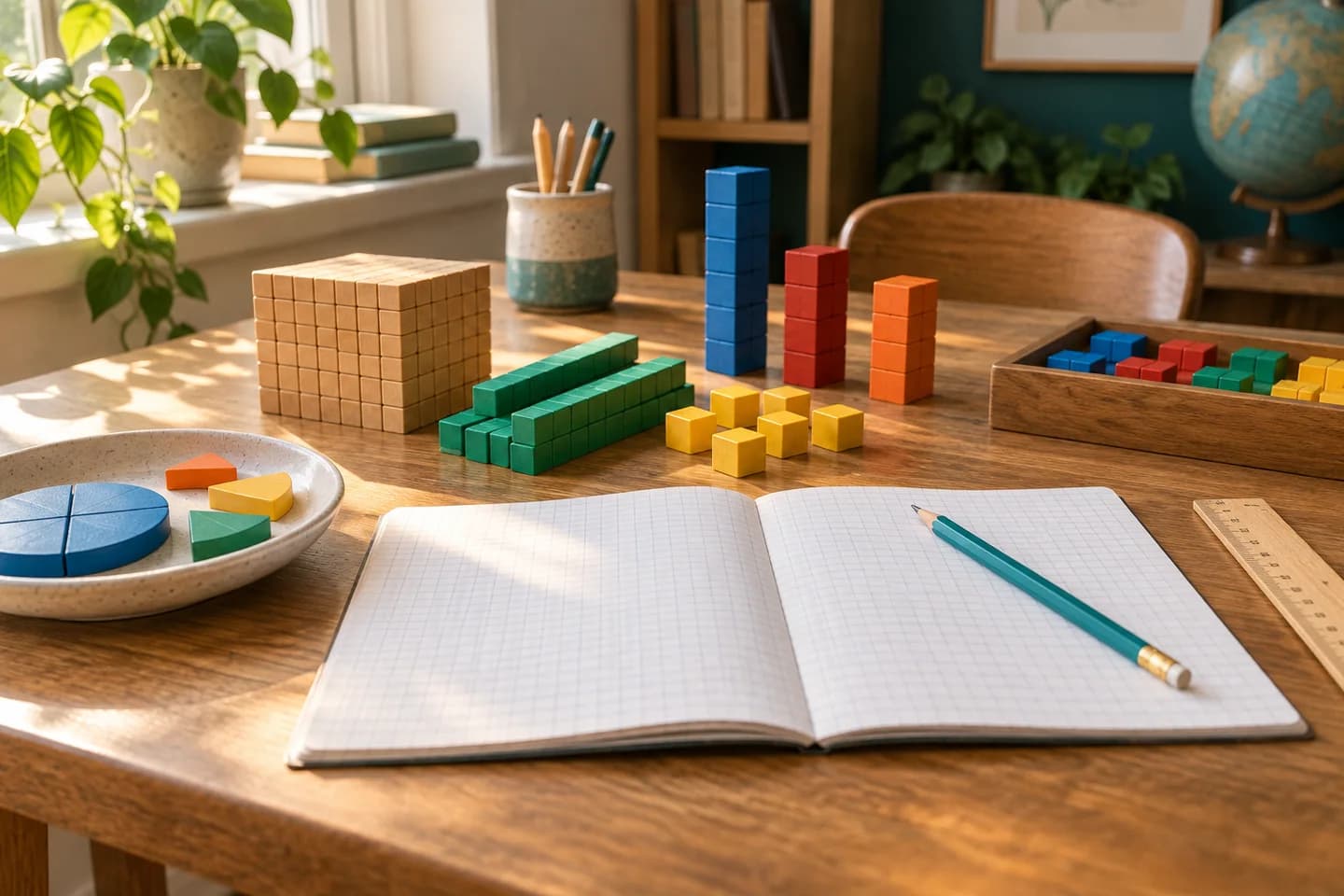
Choose a starting point
Practice at your level.
Grade labels are starting points; school sequences vary. Advanced chapters assume the prerequisites listed on their pages.
Attempt · Explain · Animate
Browse all practice chapters
281–300 of 10,000 matching chapters · Page 15 of 500
Clear filtersGrade 1 · Chapter 281
Join two small groups: objects already here: 7; objects arriving: 9
At a classroom activity, a first group contains 7 counters and another group brings 9 counters. Find the total after both groups join, explain the calculation, and check a related question.
Question · Worked solution · Animated example
Open practice chapterGrade 1 · Chapter 282
Remove a part and recount: starting objects: 11; objects taken away: 9
At a classroom activity, 11 counters are available and 9 are taken away. Find the number left after the removal, explain the calculation, and check a related question.
Question · Worked solution · Animated example
Open practice chapterGrade 1 · Chapter 283
Compare by making pairs: first group: 14; second group: 12
Two groups at a classroom activity hold 14 counters and 12 counters. Find the larger group and the difference between the two counts, explain the calculation, and check a related question.
Question · Worked solution · Animated example
Open practice chapterGrade 1 · Chapter 284
See ten and the extra part: counters already placed: 10; counters to bring: 2
A display at a classroom activity begins with 10 counters and has 2 more ready to join. Find the total after the arriving counters join and the original missing part of ten, explain the calculation, and check a related question.
Question · Worked solution · Animated example
Open practice chapterGrade 1 · Chapter 285
Count forward from a starting point: starting position: 10; size of each jump: 1; number of jumps: 3
A position marker at a classroom activity starts at 10 and makes 3 forward jumps of 1 units each. Find the endpoint after the stated jumps, explain the calculation, and check a related question.
Question · Worked solution · Animated example
Open practice chapterGrade 1 · Chapter 286
Align ends to compare lengths: first strip length: 6 units; second strip length: 6 units
A design for a classroom activity uses strips of lengths 6 and 6 equal units. Find the longer strip and the difference between the lengths, explain the calculation, and check a related question.
Question · Worked solution · Animated example
Open practice chapterGrade 1 · Chapter 287
Share fairly between two or four: objects to share: 13; number of recipients: 4
At a classroom activity, 13 counters must be shared among 4 recipients. Find the equal whole-object share and the remainder, explain the calculation, and check a related question.
Question · Worked solution · Animated example
Open practice chapterGrade 1 · Chapter 288
Read three picture counts: category a count: 5; category b count: 7; category c count: 0
A survey display at a classroom activity records three category counts: 5 counters, 7 counters, and 0 counters. Find the total count and the largest and smallest category counts, explain the calculation, and check a related question.
Question · Worked solution · Animated example
Open practice chapterGrade 1 · Chapter 289
Join two small groups: objects already here: 4; objects arriving: 5
At a classroom activity, a first group contains 4 counters and another group brings 5 counters. Find the total after both groups join, explain the calculation, and check a related question.
Question · Worked solution · Animated example
Open practice chapterGrade 1 · Chapter 290
Remove a part and recount: starting objects: 19; objects taken away: 4
At a classroom activity, 19 counters are available and 4 are taken away. Find the number left after the removal, explain the calculation, and check a related question.
Question · Worked solution · Animated example
Open practice chapterGrade 1 · Chapter 291
Compare by making pairs: first group: 13; second group: 4
Two groups at a classroom activity hold 13 counters and 4 counters. Find the larger group and the difference between the two counts, explain the calculation, and check a related question.
Question · Worked solution · Animated example
Open practice chapterGrade 1 · Chapter 292
See ten and the extra part: counters already placed: 7; counters to bring: 9
A display at a classroom activity begins with 7 counters and has 9 more ready to join. Find the total after the arriving counters join and the original missing part of ten, explain the calculation, and check a related question.
Question · Worked solution · Animated example
Open practice chapterGrade 1 · Chapter 293
Align ends to compare lengths: first strip length: 13 units; second strip length: 18 units
A design for a classroom activity uses strips of lengths 13 and 18 equal units. Find the longer strip and the difference between the lengths, explain the calculation, and check a related question.
Question · Worked solution · Animated example
Open practice chapterGrade 1 · Chapter 294
Read three picture counts: category a count: 10; category b count: 7; category c count: 8
A survey display at a classroom activity records three category counts: 10 counters, 7 counters, and 8 counters. Find the total count and the largest and smallest category counts, explain the calculation, and check a related question.
Question · Worked solution · Animated example
Open practice chapterGrade 1 · Chapter 295
Join two small groups: objects already here: 1; objects arriving: 1
At a classroom activity, a first group contains 1 counter and another group brings 1 counter. Find the total after both groups join, explain the calculation, and check a related question.
Question · Worked solution · Animated example
Open practice chapterGrade 1 · Chapter 296
Remove a part and recount: starting objects: 13; objects taken away: 7
At a classroom activity, 13 counters are available and 7 are taken away. Find the number left after the removal, explain the calculation, and check a related question.
Question · Worked solution · Animated example
Open practice chapterGrade 1 · Chapter 297
Compare by making pairs: first group: 12; second group: 17
Two groups at a classroom activity hold 12 counters and 17 counters. Find the larger group and the difference between the two counts, explain the calculation, and check a related question.
Question · Worked solution · Animated example
Open practice chapterGrade 1 · Chapter 298
See ten and the extra part: counters already placed: 4; counters to bring: 5
A display at a classroom activity begins with 4 counters and has 5 more ready to join. Find the total after the arriving counters join and the original missing part of ten, explain the calculation, and check a related question.
Question · Worked solution · Animated example
Open practice chapterGrade 1 · Chapter 299
Count forward from a starting point: starting position: 1; size of each jump: 2; number of jumps: 4
A position marker at a classroom activity starts at 1 and makes 4 forward jumps of 2 units each. Find the endpoint after the stated jumps, explain the calculation, and check a related question.
Question · Worked solution · Animated example
Open practice chapterGrade 1 · Chapter 300
Align ends to compare lengths: first strip length: 20 units; second strip length: 10 units
A design for a classroom activity uses strips of lengths 20 and 10 equal units. Find the longer strip and the difference between the lengths, explain the calculation, and check a related question.
Question · Worked solution · Animated example
Open practice chapter