
Math With Amar · Guided practice
10,000 ways to practice.
One idea at a time.
Each chapter gives you a distinct mathematical scenario: one question to attempt, a hint, a worked solution, and an animated example you can control.
10,000 questions · 10,000 animated scenarios · 14 study levels
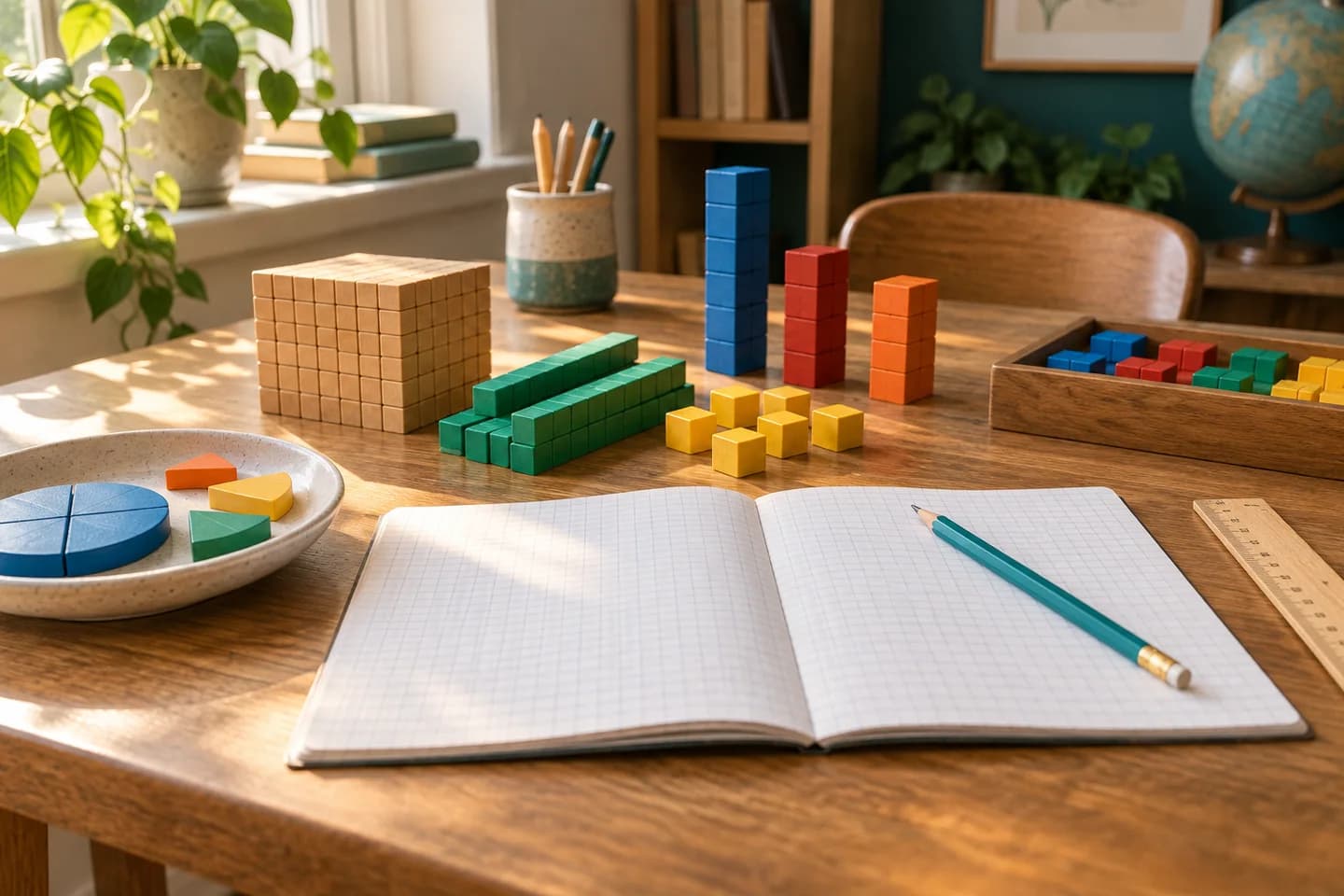
Choose a starting point
Practice at your level.
Grade labels are starting points; school sequences vary. Advanced chapters assume the prerequisites listed on their pages.
Attempt · Explain · Animate
Grade 2 practice chapters
1–20 of 750 matching chapters · Page 1 of 38
Clear filtersGrade 2 · Chapter 1
Read hundreds tens and ones: hundreds digit: 4; tens digit: 4; ones digit: 2
An inventory at a classroom activity records 4 hundreds, 4 tens, and 2 ones of counters. Find the total represented by the hundreds, tens, and ones, explain the calculation, and check a related question.
Question · Worked solution · Animated example
Open practice chapterGrade 2 · Chapter 2
Add through a new ten: first amount: 23; second amount: 33
At a classroom activity, a first group contains 23 counters and another group brings 33 counters. Find the total after both groups join, explain the calculation, and check a related question.
Question · Worked solution · Animated example
Open practice chapterGrade 2 · Chapter 3
Subtract from a larger collection: starting amount: 337; amount removed: 8
At a classroom activity, 337 counters are available and 8 are taken away. Find the number left after the removal, explain the calculation, and check a related question.
Question · Worked solution · Animated example
Open practice chapterGrade 2 · Chapter 4
Land on repeated equal jumps: starting position: 19; size of each jump: 5; number of jumps: 10
A position marker at a classroom activity starts at 19 and makes 10 forward jumps of 5 units each. Find the endpoint after the stated jumps, explain the calculation, and check a related question.
Question · Worked solution · Animated example
Open practice chapterGrade 2 · Chapter 5
Rows make repeated addition visible: rows: 3; objects per row: 3
A rectangular arrangement for a classroom activity has 3 rows with 3 counters in each row. Find the number of objects in the original array, explain the calculation, and check a related question.
Question · Worked solution · Animated example
Open practice chapterGrade 2 · Chapter 6
Deal equal shares and keep leftovers: objects available: 32; recipients: 4
At a classroom activity, 32 counters must be shared among 4 recipients. Find the equal whole-object share and the remainder, explain the calculation, and check a related question.
Question · Worked solution · Animated example
Open practice chapterGrade 2 · Chapter 7
Repeat equal measuring units: equal units laid end to end: 9; length of each unit: 4 cm
A measuring strip for a classroom activity is assembled from 9 equal pieces, each 4 cm long. Find the length of the original strip in centimetres, explain the calculation, and check a related question.
Question · Worked solution · Animated example
Open practice chapterGrade 2 · Chapter 8
Trace all four boundary lengths: rectangle width: 11; rectangle height: 8
A rectangular plan for a classroom activity measures 11 units across and 8 units high. Find the original perimeter and area, explain the calculation, and check a related question.
Question · Worked solution · Animated example
Open practice chapterGrade 2 · Chapter 9
Read minutes around the clock: starting whole hour: 2; minutes past that hour: 40
An activity at a classroom activity starts at 2:00 and runs for 40 minutes. Find the clock reading at the planned end, explain the calculation, and check a related question.
Question · Worked solution · Animated example
Open practice chapterGrade 2 · Chapter 10
Compare counts on a common scale: category a: 26; category b: 26; category c: 3
A survey display at a classroom activity records three category counts: 26 counters, 26 counters, and 3 counters. Find the total count and the largest and smallest category counts, explain the calculation, and check a related question.
Question · Worked solution · Animated example
Open practice chapterGrade 2 · Chapter 11
Read hundreds tens and ones: hundreds digit: 3; tens digit: 6; ones digit: 8
An inventory at a classroom activity records 3 hundreds, 6 tens, and 8 ones of counters. Find the total represented by the hundreds, tens, and ones, explain the calculation, and check a related question.
Question · Worked solution · Animated example
Open practice chapterGrade 2 · Chapter 12
Add through a new ten: first amount: 82; second amount: 17
At a classroom activity, a first group contains 82 counters and another group brings 17 counters. Find the total after both groups join, explain the calculation, and check a related question.
Question · Worked solution · Animated example
Open practice chapterGrade 2 · Chapter 13
Subtract from a larger collection: starting amount: 120; amount removed: 40
At a classroom activity, 120 counters are available and 40 are taken away. Find the number left after the removal, explain the calculation, and check a related question.
Question · Worked solution · Animated example
Open practice chapterGrade 2 · Chapter 14
Land on repeated equal jumps: starting position: 9; size of each jump: 2; number of jumps: 7
A position marker at a classroom activity starts at 9 and makes 7 forward jumps of 2 units each. Find the endpoint after the stated jumps, explain the calculation, and check a related question.
Question · Worked solution · Animated example
Open practice chapterGrade 2 · Chapter 15
Rows make repeated addition visible: rows: 4; objects per row: 9
A rectangular arrangement for a classroom activity has 4 rows with 9 counters in each row. Find the number of objects in the original array, explain the calculation, and check a related question.
Question · Worked solution · Animated example
Open practice chapterGrade 2 · Chapter 16
Deal equal shares and keep leftovers: objects available: 37; recipients: 2
At a classroom activity, 37 counters must be shared among 2 recipients. Find the equal whole-object share and the remainder, explain the calculation, and check a related question.
Question · Worked solution · Animated example
Open practice chapterGrade 2 · Chapter 17
Repeat equal measuring units: equal units laid end to end: 10; length of each unit: 2 cm
A measuring strip for a classroom activity is assembled from 10 equal pieces, each 2 cm long. Find the length of the original strip in centimetres, explain the calculation, and check a related question.
Question · Worked solution · Animated example
Open practice chapterGrade 2 · Chapter 18
Trace all four boundary lengths: rectangle width: 4; rectangle height: 5
A rectangular plan for a classroom activity measures 4 units across and 5 units high. Find the original perimeter and area, explain the calculation, and check a related question.
Question · Worked solution · Animated example
Open practice chapterGrade 2 · Chapter 19
Read minutes around the clock: starting whole hour: 7; minutes past that hour: 15
An activity at a classroom activity starts at 7:00 and runs for 15 minutes. Find the clock reading at the planned end, explain the calculation, and check a related question.
Question · Worked solution · Animated example
Open practice chapterGrade 2 · Chapter 20
Compare counts on a common scale: category a: 23; category b: 0; category c: 23
A survey display at a classroom activity records three category counts: 23 counters, 0 counters, and 23 counters. Find the total count and the largest and smallest category counts, explain the calculation, and check a related question.
Question · Worked solution · Animated example
Open practice chapter